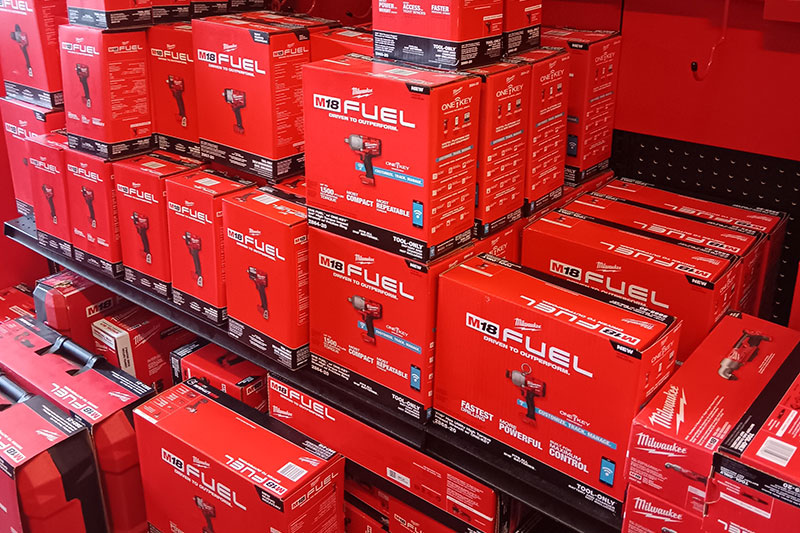
If you’ve ever searched for a Milwaukee tool online, you’ve probably noticed something strange: there seem to be a lot of versions of the same tool.
You might find two drills that look almost identical, but they have different model numbers and different prices. Then you see an M18 version, an M12 version, a FUEL version, a newer generation, and a few different kits.
So what’s the difference?
It’s a question we hear at Straub Tool Shop fairly often, and the answer is usually simpler than it looks.
They aren’t always actually the same tool
The first thing to understand is that Milwaukee makes tools for different applications and different types of users.
Take drills. A compact drill might be designed for someone who spends most of the day working in tight spaces, while a larger hammer drill may be built for someone who needs more power for demanding applications.
They may look similar sitting on a shelf, but they’re designed with different priorities in mind.
M12 and M18 are different platforms
This is one of the easiest differences to spot.
M12 and M18 are separate Milwaukee battery platforms. M12 tools are generally smaller and lighter, while M18 tools cover a much larger range of professional applications.
Neither platform is simply “better.” It depends on the job.
Someone working in a tight electrical box may appreciate the size of an M12 tool. Someone drilling large holes all day may want the power and runtime of M18.
FUEL is another difference
You’ll also see Milwaukee tools offered in both FUEL and non-FUEL versions.
FUEL tools use Milwaukee’s more advanced motor and electronic technology and are generally designed for higher performance and more demanding use.
That doesn’t mean everyone needs a FUEL tool.
If you’re using a drill occasionally around the house, you may not get enough benefit from the extra cost to justify it. For someone using that drill every day, the additional performance may be well worth it.
New generations create new model numbers
Milwaukee also continually updates its tools.
A newer version may have a more powerful motor, improved electronics, better ergonomics, or other changes. Sometimes the difference is substantial; sometimes it’s relatively minor.
That’s why two Milwaukee tools can look almost identical while having different model numbers.
An older model isn’t automatically a bad tool, either. If it’s being discounted, it can sometimes be a very good value.
Don’t forget about kits
Sometimes the tool itself isn’t different at all—the package is.
One listing might be for a tool only, while another includes batteries, a charger, or other accessories.
This is one of the easiest ways to accidentally compare apples to oranges when shopping online.
A $199 tool might look cheaper than a $249 one until you realize the $249 package includes a battery and charger.
Pay attention to the model number
If there’s one thing we’d recommend when comparing Milwaukee tools, it’s this:
Compare the model numbers, not just the pictures.
The model number tells you exactly which version you’re looking at. It’s much more reliable than assuming two tools are the same because they look alike in product photos.
So which one should you buy?
There isn’t always a reason to buy the newest or most expensive version.
If you’re a professional using a tool every day, spending more for additional performance may make sense. If you’re an occasional user, a less expensive model may do everything you need.
And sometimes an older model on sale is an excellent buy.
At Straub Tool Shop, we see this pretty regularly. Someone comes in looking at two Milwaukee tools and assumes the more expensive one must be better. Once we compare the models and talk about how they’re actually going to use the tool, that’s not always the case.
The best Milwaukee tool isn’t necessarily the most expensive one. It’s the one that makes sense for the job you’re doing.
So the next time you see five different Milwaukee drills that look almost the same, don’t worry. Look at the model numbers, compare what actually changed, and decide which features you really need.
Once you get used to it, the Milwaukee lineup isn’t nearly as confusing as it first appears.